
Last updated October 30, 2026
 Architectural shingles
 Metal roofing
 Tile roofing
 GAF
 Owens Corning
 Flat & low-slope
Free roof inspection with deck photos before we talk money - GAF and Owens Corning certified installation
Roof Repair Maintenance Checklist for Murrieta Homeowners
The most expensive roof repairs in Murrieta don’t start with a storm. They start with a $12 tube of caulk that nobody replaced for three years around a pipe boot flashing. By the time water shows up on a hallway ceiling, that half-dollar-sized crack has been wicking moisture into the decking through two full rain seasons. This guide walks through the maintenance tasks that actually prevent that scenario, organized around the specific failure points we see repeatedly across Murrieta’s neighborhoods – from the UV-cooked southern exposures in Copper Canyon to the wind-scoured ridgelines in West Murrieta.
Quick Answer
A roof maintenance checklist for a Murrieta homeowner should follow a twice-yearly rhythm: a pre-rain inspection every October focused on flashing integrity, pipe boots, and valley seams, plus a post-rain walk in March looking for lifted shingles and granule loss. The highest-priority items are replacing cracked pipe boot collars every 3-5 years, keeping flashings sealed at ridgelines and valleys before the November-February rain window, and confirming attic ventilation is actually moving air – not just installed. Most other tasks are observational and take under an hour.
Styles & brands we work with
Table of Contents
- The Murrieta Failure Points Most Checklists Miss
- Pipe Boot Flashings: The $12 Caulk Problem
- Ridge Caps and Valley Seams: Where Water Finds the Gap
- Attic Ventilation: The Inland Valley Heat Problem
- The Murrieta Maintenance Calendar
- What a Homeowner Can Safely Observe vs. What a Specialist Should Do
- Documenting Your Roof: Building a Baseline
- Common Mistakes to Avoid
- When to Call a Professional
- Frequently Asked Questions
The Murrieta Failure Points Most Checklists Miss
National roof maintenance checklists tell you to clean your gutters, which is fine advice, but it skips over what actually fails on roofs in this part of Riverside County. Murrieta sits in a climate that’s gentle on roofs in some ways – we don’t get freeze-thaw cycles that crack shingles like the Midwest does – but brutal in others. The combination of 260+ days of intense UV exposure per year and a concentrated rain window from November through February creates a very specific failure pattern.
UV radiation is the silent killer here. Asphalt shingles lose their volatile oils year after year under the Inland Empire sun. The south-facing and west-facing roof planes on hillside homes in Murrieta – think the slopes above Clinton Keith Road or parts of Bear Creek – age visibly faster than north-facing planes. We’ve inspected roofs in the same neighborhood where one side of the house looks five years older than the other. That uneven aging isn’t cosmetic. The brittle side becomes the side that cracks at the first heavy wind event.
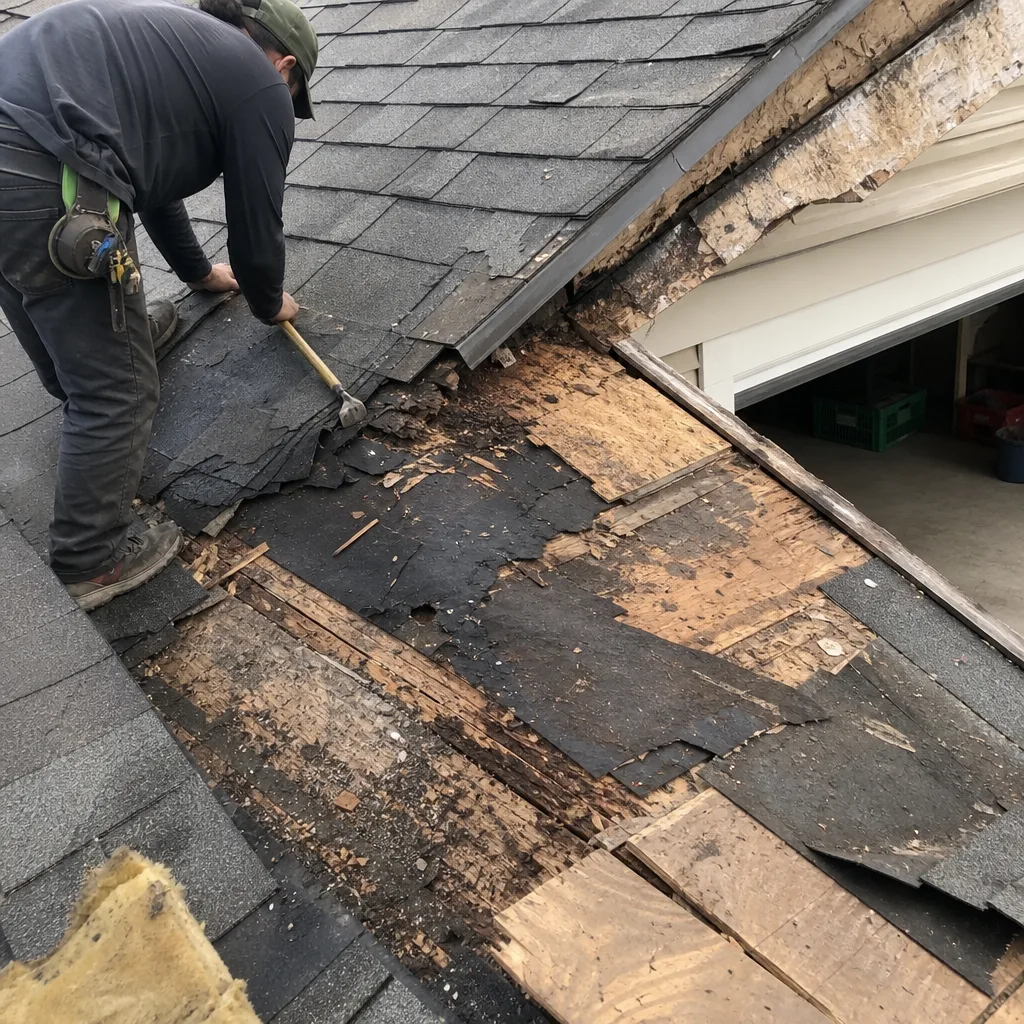
Then there’s dry rot. It sounds like something out of a coastal fog zone, but Murrieta gets enough cumulative moisture – heavy morning dew cycles during the winter months plus the wet season itself – that wooden roof decking and trim don’t need to stay wet long to start deteriorating. Dry rot spores activate at around 20% moisture content in wood. Once a small leak starts at a flashing point, the decking around it cycles between damp and dry every week from November to March. Over two or three years, that’s enough to create rot pockets that turn a simple shingle repair into a decking replacement.
This guide is built around those two forces: UV fatigue and intermittent moisture. Everything else follows from them.
Pipe Boot Flashings: The $12 Caulk Problem
Every plumbing vent pipe that penetrates your roof is sealed with a pipe boot – a rubber or neoprene collar that slides over the pipe and flashes it against the shingles. The rubber collar is the weak point. Under Murrieta’s UV load, those collars dry out, crack, and split open. The failure usually starts as a hairline crack on the sunny side of the collar, which is exactly where a homeowner looking from the ground won’t see it.
Pipe boot failure is the single most common source of preventable roof leaks we find in Murrieta homes. The frustrating part is that the fix is inexpensive when caught early – a new pipe boot and some roof sealant run about $20 in materials, and a roofer can swap one out in under an hour. Left alone, the leak works its way down the pipe, follows the underside of the decking, and shows up months later as a ceiling stain nowhere near the actual penetration. By then, the decking is soft, and the repair bill is five to ten times higher.
What to check from the ground, twice a year:
- Look at the pipe collars visible from the yard or street. If you can see the rubber part flaking, cracking, or separating from the pipe, it’s time to replace it.
- After the first good rain in November, check the attic around any vent pipes with a flashlight. Look for a dark moisture ring on the wood around the pipe. That’s the earliest sign of a boot leak, and it often shows before a ceiling does.
- If your home has multiple plumbing vents – most Murrieta houses have at least two, and two-story homes often have four or more – check every one. They age at different rates depending on sun exposure.
- Any caulking visible around the base of a vent pipe from the exterior is a red flag. It means someone patched a boot problem from the outside instead of replacing the boot. Patches on pipe boots last about one season in this climate.
If you’re not sure whether it’s time to replace a boot, the answer is usually yes if the home is more than seven years old and the boots are original. UV damage accelerates after year seven, and by year ten, almost every original boot in Murrieta has visible cracking.
Ridge Caps and Valley Seams: Where Water Finds the Gap
After pipe boots, the next most common failure points on Murrieta roofs are the ridge caps along the peak of the roof and the valley seams where two roof planes meet. These are the high-stress, high-exposure areas where installed materials take the worst beating from wind and sun. They’re also the hardest places for a homeowner to inspect closely because they sit at the highest, most visually awkward angles.
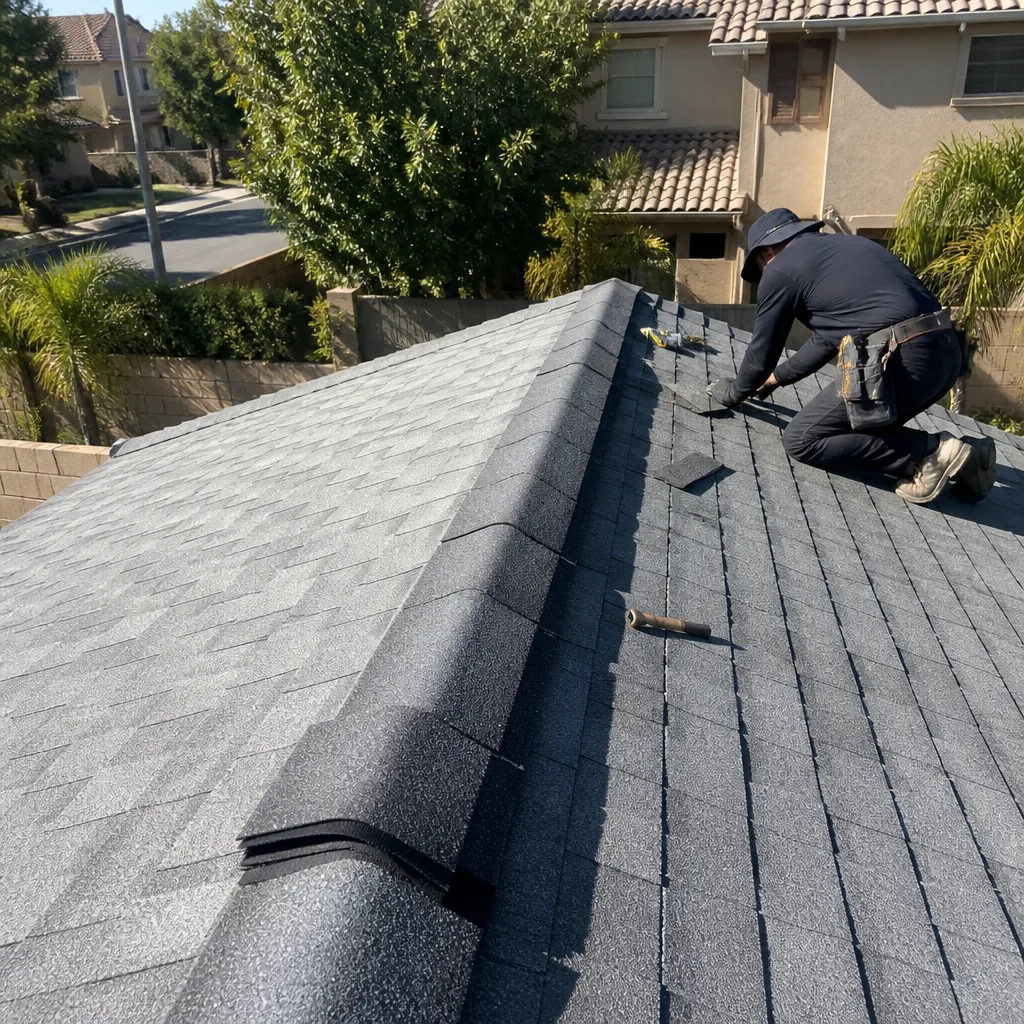
Ridge caps are the shingles that cap the ridgeline – the top edge where two roof slopes meet. They’re often cut from the same shingle material but installed differently, and they’re very often sealed with asphalt plastic cement or sealant at installation. That sealant dries out in the Murrieta heat, especially on ridgelines with direct southern exposure. When the sealant fails, the ridge caps lift at the edges. Wind gets under them, and eventually the cap shingle tears off. We see missing ridge caps after almost every strong Santa Ana event, and the failure is almost always traceable back to degraded sealant that would have been caught in a pre-wind-season inspection.
What to look for on ridge caps:
- From the front yard or street, scan the ridgeline. Look for shingles that appear raised at the corners, even slightly. A flat ridgeline that looks “bumpy” is a sign that caps are lifting.
- After any wind event over 30 mph – which happens several times per year in Murrieta, especially in the fall – do a quick visual pass for missing cap pieces. Missing ridge caps expose the raw seam where the two roof planes meet, and that seam will take water within weeks.
- Look for dark staining along the ridgeline. That’s often granule loss from cap shingles that are nearing end of life.
Valley seams are where two roof planes converge. In Murrieta, many homes use open metal valleys – a strip of metal flashing fixed into the valley center – because they handle the concentrated water flow during our heavy but infrequent rain events better than woven or closed-cut valleys in some installs. The critical vulnerability is at the edges of the valley, where the shingles butt against the metal. If the shingles were not cut cleanly or were sealed improperly, water can curl under the shingle edge and into the roof deck.
We don’t recommend that homeowners walk valleys to inspect them. But you can spot-check valley health from a ladder at the eave or from an upstairs window that overlooks the roof. Look for shingle edges lifting away from the metal, debris or granules piling in the valley center (a sign of heavy shingle wear above the valley), or visible rust on older valley metal. Any of those signals warrants a closer professional look before the rain starts.
Attic Ventilation: The Inland Valley Heat Problem
Here’s something most maintenance lists don’t cover: the health of your roof depends heavily on what’s happening inside your attic, not just on top of your house. Murrieta summers push attic temperatures to 140 degrees or higher on a regular July afternoon. That superheated air bakes the underside of your roof decking at the same time the sun is baking the shingle surface from above. The result is shingles that age from both directions – and an attic that never cools properly.
The Inland Valley has a well-documented pattern of under-ventilated attics. Homes built during the big Murrieta development waves of the 1990s and 2000s often have the minimum code-required ventilation, and code minimums don’t account for how much heat accumulates in attics that get hit with this much direct sun. Add in the fact that many homeowners store things in attics that block soffit vents, and you have a recipe for systematic roof failure that has nothing to do with the shingles themselves.
Signs that your attic ventilation is inadequate:
- Felt or decking paper in the attic that looks shiny and brittle on the underside – that’s heat damage from the decking side.
- An attic that’s noticeably hotter than outside air temperature on a summer morning – if the attic is still 120 degrees at 9 AM in July, it’s not ventilating overnight.
- Shingles on the roof that are curling at the edges in a uniform pattern across a large area – that’s heat-driven curl, not age-driven curl.
- A spike in cooling bills in the summer, because attic heat is radiating into the living space and making the AC work harder.
- Condensation or moisture staining on the underside of the roof deck in winter – under-ventilated attics trap moisture as well as heat.
The most common type of attic ventilation on Murrieta homes is passive: soffit vents at the eaves pulling air in, and either ridge vents or static box vents at the top letting hot air out. That works only if the soffit vents aren’t blocked. We’ve found attics where insulation was blown directly over the soffit vents during a retrofit, turning the ventilation system into a sealed box. If you can access the attic, run a quick check on the soffit areas – you should be able to see daylight at the edges of the attic floor when you look from inside. No daylight means no airflow, and no airflow means your shingles are cooking from the inside.
Poor ventilation is one of the fastest ways to void a manufacturer’s shingle warranty. Most major brands – including the ones in the Rosewood portfolio like Owens Corning and IKO systems we install – specifically exclude heat damage caused by inadequate ventilation from warranty coverage. That’s a hidden cost risk most homeowners don’t learn about until a claim gets denied.
The Murrieta Maintenance Calendar
General maintenance guides say to check your roof “in the spring and fall.” That’s vague and not particularly useful for this climate, because Murrieta’s rain comes in a narrow window. If you miss October, you’ve missed the prep window for essentially the entire wet season. Here’s the realistic calendar, matched to what actually happens here.
September – Early October: The Pre-Rain Inspection
This is the most important maintenance block of the year. The rain arrives in November in most years, sometimes as early as late October, and Santa Ana winds often hit in September and October. Your roof needs to be sound before both of those events.
- Do the full ground-level visual scan: ridgeline, pipe boots, valleys (from the safest vantage point available), and all flashings around chimneys and skylights if visible.
- Clean the gutters or have them cleaned. This is the one generic task that matters here, because the first big rain after eight months of dry conditions carries a year’s worth of dust, leaves, and debris straight into your gutters. Clogged gutters back water up under the roof edge.
- Check the attic with a flashlight for any sign of moisture staining, especially around pipe penetrations and at the underside of any valley.
- Trim back any tree branches overhanging the roof. The late-season dry conditions mean branches are brittle, and a wind event will snap them and drop them onto shingles.
- If your roof is beyond about 12 years old and has never had a professional evaluation, schedule one now. This is the moment when a Roof Inspection in Murrieta pays for itself – finding a failing flashing in October is a hundred-dollar fix; finding it in January is a bigger problem.
November – February: Active Rain Season Monitoring
You’re not doing maintenance during the rain window. You’re monitoring. The goal is to catch the first sign of ingress before it becomes visible on a ceiling.
- After the first significant rain, check the attic again with a flashlight. Look for darkening wood, wet insulation, or water beading on the underside of the deck.
- Watch the ceilings in rooms under flat roof areas (if your home has any flat roof sections, common on some Murrieta patio covers and additions). Flat roofs show leaks faster and leak more aggressively.
- If we get a heavy downpour – the kind that drops an inch in a few hours – do a quick visual check of exterior walls under the roofline for water running down the wall, which indicates gutter overflow or wicking at the roof edge.
March – April: Post-Rain Assessment and Repair Window
Once the rain stops, usually by late March or early April, you have a window to fix anything that revealed itself during the wet season. This is the ideal time for maintenance repairs in Murrieta because the weather is cooperative and prices and scheduling are more flexible than during the pre-rain rush.
- Walk the property and look for shingle tabs that have lifted, shifted, or detached during the winter’s wind events.
- Check the ridgeline for missing cap shingles.
- Examine the pipe boots for any new cracking that developed over the wet season – boots that were marginal in October often fail visibly by March.
- Look for granule accumulation in the gutters. A thin layer of granules is normal. A heavy, consistent layer of granules every time you clean indicates the shingle surface is wearing aggressively.
June – August: Attic Ventilation Check in Extreme Heat
Summer isn’t a roof maintenance season in the traditional sense, but it’s when heat-driven problems reveal themselves. The best time to assess attic ventilation is a hot, still afternoon in July or August, because the contrast between a functional vent system and a failing one is most obvious. Check for the ventilation red flags described in the section above. Also watch for heat-driven shingle curl – shingles that are developing a visible cup or wave pattern across the roof surface. This is the earliest visual sign that your roof is aging faster than it should.
What a Homeowner Can Safely Observe vs. What a Specialist Should Do
There’s a hard line between roof maintenance and roof work, and confusing the two is where injuries happen. Falls from roofs in Riverside County are a real, documented risk – a significant portion of the ladder and roofer injuries we see in the broader trade are DIYers who went one step past what their experience justified. Here’s where that line is.
Safe homeowner maintenance tasks, done from the ground or a ladder at the eave:
- Visual inspection of the ridgeline, flashings, pipe boots, and valleys from the yard, driveway, or an upstairs window
- Gutter cleaning from a properly secured extension ladder
- Attic inspection from inside the attic access point
- Using a smartphone camera or binoculars to zoom in on suspect areas from the ground
- Documenting your roof’s condition with dated photos each season
Tasks that belong to a roofing specialist:
- Anything that requires walking on the roof surface. Walking on an asphalt shingle roof when you don’t know what you’re doing damages shingles – especially in summer when the granules are soft and loose – and puts you at risk. The slope of many Murrieta hillside homes makes this genuinely dangerous.
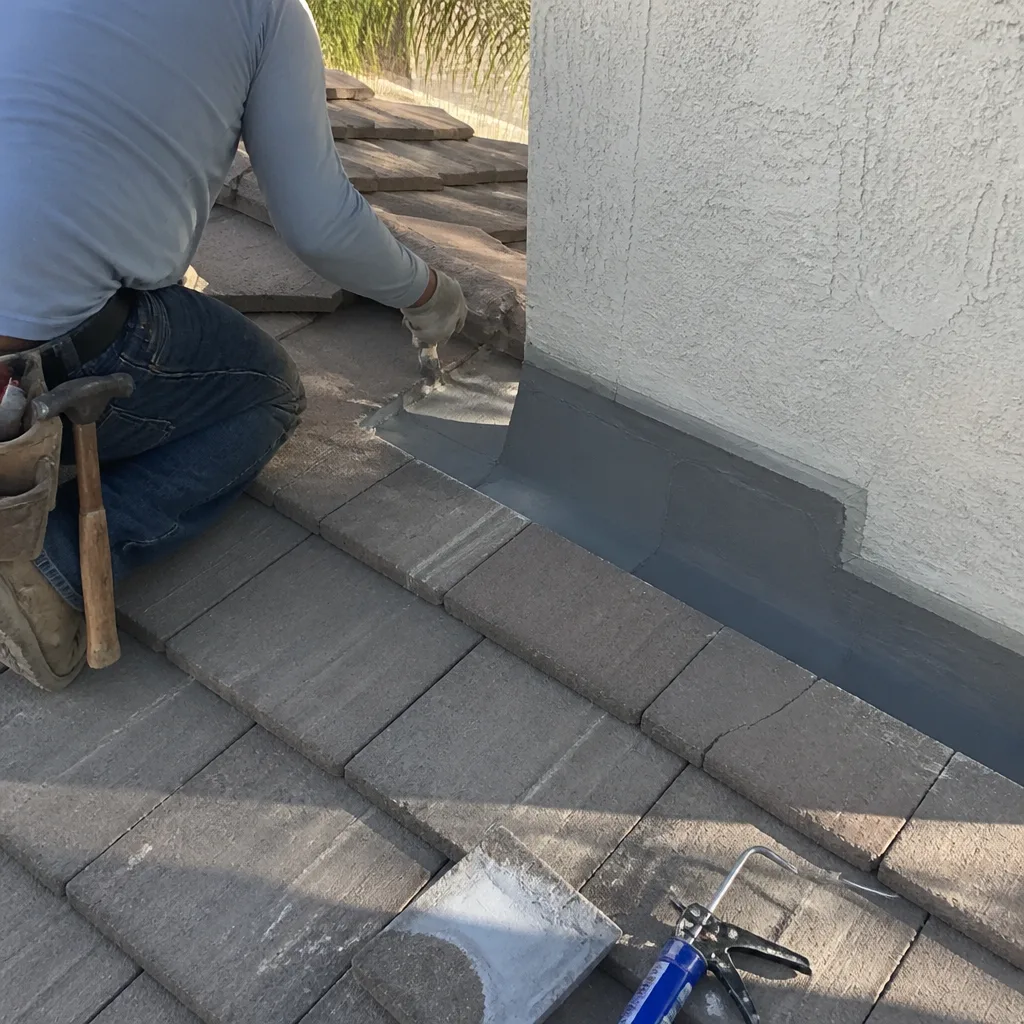
- Replacing pipe boots or resealing flashings. This is a small job, but it requires working at height with tools and materials, on a surface that’s often brittle from UV exposure. The cost of having a pro do it is low relative to the cost of a fall.
- Any repair that involves the roof decking. If you can see or feel softness in the deck from inside the attic, the roof structure is already compromised. That’s a structural repair, not a maintenance task.
- Inspections that involve walking the entire roof plane, checking for soft spots, and evaluating sealant condition up close. This is what a Roof Inspection in Murrieta is for, and it should be done by someone who knows what a failing sealant bead looks like under close inspection.
Our rule of thumb: if the task requires both feet on the roof surface, or if it requires evaluating something you can’t fully see from where you’re standing, call a specialist. The risk calculus doesn’t support the DIY route.
Documenting Your Roof: Building a Baseline
Here’s a maintenance practice almost no one does, and it has real financial consequences. Your roof has a lifespan, and every repair conversation you’ll ever have with a contractor revolves around condition assessment. When you bring a roofer out and they tell you the roof is failing, you need your own data to evaluate that claim. Most homeowners have nothing but their memory of “I think it was replaced around 2008.”
Start a simple documentation routine. It takes fifteen minutes twice a year and gives you a dated, photographic record of the roof’s condition over time.
- Take a series of photos from the same positions each season: front of the house from the street, back of the house from the yard, both sides from the property line, and a close-up of the ridgeline and any visible pipe boots. Use your phone’s location stamp and date stamp – both are built into the camera by default now.
- Store those photos in a folder named by season and year, backed up to cloud storage.
- Make a note when you observe something new: “March 2026: observed granule buildup in gutter at west side of house.” Notes with dates carry weight when you’re disputing a claim or comparing quotes.
- Keep records of any roof work done by previous owners, if you have them. A roofing file with the original install date, material type, and warranty paperwork from the prior owner is worth having. Most homeowners inherit a roof with no documentation.
- If you get a professional inspection, ask for the written report and file it. You’re building an evidentiary trail that supports or contradicts any future “your roof is at end of life” conversation.
This documentation does two things. It protects you from overstated repair scopes, and it helps you plan proactively for replacement. If your photos show a clear pattern of progressive shingle deterioration over three years, you have a data-backed trigger for a Roof Replacement in Murrieta conversation – rather than waiting for a leak to force the decision.
Common Mistakes to Avoid
- Applying caulk or roof sealant as a permanent fix on flashings. Caulk is a temporary bandage in the Murrieta sun. UV breaks it down within one or two seasons, and it often masks a flashing failure that would be better addressed by replacing the flashing component. Recaulking the same spot year after year means the actual problem was never fixed.
- Ignoring the south-facing roof plane. Homeowners often walk their property and see the north-facing plane, which looks fine, and assume the whole roof is in similar shape. On many Murrieta homes, the south and west planes are three to five years ahead in the aging curve. Inspect every plane.
- Cleaning gutters but never looking at the roof edge while doing it. When you’re on the ladder at the gutter line, you’re in a good position to check the drip edge and the first course of shingles. Deterioration often starts at the eave, where water runs off and backs up in wind. Most people never look.
- Assuming a new roof means no maintenance is needed for a decade. New roofs still have pipe boots, flashings, and ridge caps. Those components need inspection just as much as they do on an aging roof. We see year-old roofs with failed boot collars from sun exposure during their first Murrieta summer.
- Waiting until a leak appears before doing anything. By the time water is visible inside the house, the roof has been leaking through the decking for weeks or months. The most expensive repairs we quote in Murrieta are almost always cases where a small, cheap problem at the roof surface was ignored long enough to rot the decking and damage insulation.
- Letting a handyman or general contractor do roofing repairs. Roofs require specialized knowledge of flashing systems, material compatibility, and manufacturer installation specs. A generalist who does “everything” doesn’t have the brand training that a roofing-only contractor maintains. The cost difference on the front end is rarely worth the repeat problem.
When to Call a Professional
Some things are unambiguous. If you see daylight through the roof from inside the attic, that’s a call today. If a pipe boot is visibly cracked and you have stains on the ceiling below the pipe, that’s a call this week. If you had wind damage during the last Santa Ana event and you can see missing shingles or shifted ridge caps from the ground, that’s a call before the next rain. If there’s visible sagging in the roof plane, even slight, that’s a structural concern, not a maintenance item. If your roof is beyond fifteen years old and has never had a professional evaluation, that’s a call before the seasonal rain window. Rosewood Roof Repair offers free estimates in Murrieta – call (844) 900-4167 to schedule a roof check before the rain arrives.
If you’re in the market, understand one thing about us: we’re a roofing company that only does roofing. The distinction matters. From a Roof Repair in Murrieta to a Roof Inspection in Murrieta to a Roof Replacement in Murrieta, the same specialist handles your roof through its entire lifecycle. You get the right material for your roof, not just the one we keep in the truck. Seven brands. One company. Your call.
Frequently Asked Questions
Twice a year, at minimum, if you’re doing it yourself – once in early October before the rain window and once in March after the rain ends. A professional inspection every two to three years is reasonable for most Murrieta homes, and annually if the roof is beyond twelve years old. The UV load here ages roofs faster than in coastal climates, so the inspection frequency should be more aggressive than a San Diego homeowner would need.
Most individual maintenance items – pipe boot replacement, a flashing reseal, a couple of lifted shingles tacked down – run between $150 and $400 when handled by a roofing contractor. More involved maintenance like replacing a section of damaged valley flashing or resealing a full run of ridge caps might run $500 to $1,200. A full professional roof inspection with a written report is usually in the $150 to $350 range, though Rosewood Roof Repair includes inspection documentation with our Roof Repair in Murrieta estimates. Call (844) 900-4167 for an exact quote – estimates are free.
Cracked pipe boot flashings, without question. The UV intensity in this part of Riverside County destroys rubber pipe boot collars faster than almost any other climate in the country, and the failures are invisible from the ground until they’ve been leaking for months. We replace more failed pipe boots than any other single repair item across Murrieta.
You can do the observational half of maintenance yourself: visual inspections from the ground, attic checks with a flashlight, gutter cleaning from a ladder, and seasonal documentation. The physical repair tasks that require working on the roof surface – resealing flashings, replacing pipe boots, anything involving the decking – should go to a roofing specialist. The fall risk is real, and a trained roofer also knows what a properly sealed flashing looks like versus what most homeowners produce with a caulking gun.
An asphalt shingle roof in Murrieta that’s properly installed and ventilated will last fifteen to twenty years with standard architectural shingles, and twenty to twenty-five years with premium products like some Atlas and Tamko lines in our material portfolio. Poorly ventilated or badly installed roofs can fail in as little as eight to twelve years here due to heat-driven aging. The single biggest lifespan factor in this climate is attic ventilation, not the shingle brand.
No, estimates are free. We’ll inspect your roof, document what we find, and provide you with a written quote for any recommended work. Call (844) 900-4167 to schedule a free estimate in Murrieta.
The Bottom Line
Roof maintenance in Murrieta isn’t about following a generic seasonal checklist. It’s about understanding the two forces that kill roofs here – UV fatigue and intermittent moisture – and staying ahead of the specific failure points those forces create. Check your pipe boots twice a year. Watch your ridgeline after wind. Keep your attic ventilating. Document everything. And when something’s beyond what you can safely see or assess from the ground, call a specialist who does roofs and nothing else. Fifteen minutes of maintenance twice a year costs nothing. The alternative is a $12 caulk job that became a $4,000 repair. The choice is yours.
Written by the team at Rosewood Roof Repair, serving Murrieta since 2014.
See the difference
 Before
 After
 Before
 After
 Before
 After